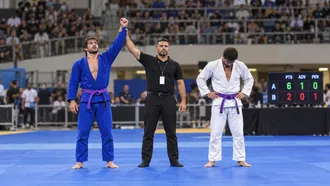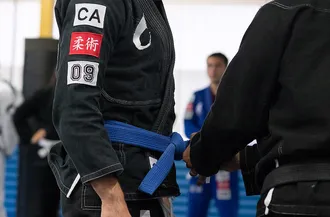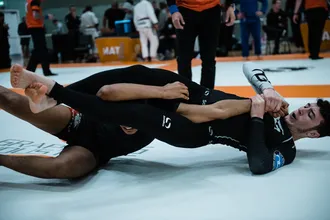
Most coaches will tell you somewhere between six months and a year of steady training before your first BJJ tournament. That's a rule of thumb, not a rule. No major organization makes you wait. The IBJJF has white belt divisions open to anyone with a gi and a registration fee, and NAGA has novice divisions built for people with under six months on the mats.
A better question is what you need to be able to do. If you can survive a full match of hard rolling, you have something to go to from top and bottom, and you know the rules well enough not to give away points, you're ready. The rest is nerves, and nothing but competing fixes those.
A Realistic Timeline
| Time training | What it usually looks like | Good first event |
|---|---|---|
| 0 to 3 months | Still learning what the positions are called. Gassing in the first round. | An in-house gym comp, if your gym runs one. |
| 3 to 6 months | A couple of escapes and one or two submissions that work on other white belts. | NAGA novice no-gi, or a small local tournament. |
| 6 to 12 months | A basic guard, a pass you trust, and enough cardio for 5 minutes of hard rolling. | Most white belt divisions: Fuji, AGF, the Revolution, NAGA beginner. |
| 1 year and up | A real game plan. Maybe a stripe or two. | An IBJJF open, if you want the full experience. |
The timeline depends on how often you train. Six months at four classes a week is a very different white belt from six months at one class a week. If you're training BJJ two or three times a week, the six-to-twelve-month window is about right.
The Readiness Checklist
Forget the calendar for a moment. If you can tick most of these, you're ready to sign up.
- You can roll hard for a full match length. For adult white belts at the IBJJF, that's 5 minutes. Not a flow roll. Five minutes of someone trying very hard to beat you.
- You have a plan from standing. A takedown you've drilled, or a guard pull you're comfortable with. Most white belt matches are lost in the first ten seconds by someone who's never thought about how to start.
- You have one thing from top and one from bottom. One guard pass. One sweep. One submission from each. That's enough.
- You know the rules. Points, the three-second hold, advantages and what's illegal at your belt. The BJJ point system and rules are easy to learn in an evening.
- You can tap without your ego getting in the way. At a tournament, people crank submissions harder than your training partners do. "Tap early, tap often" applies double.
- You've rolled with people outside your gym. Hitting the Saturday open mat at another academy is the closest thing to a tournament you can do for free.
- Your coach thinks you're ready. Ask. Most coaches love it when students want to compete, and they'll tell you straight if you're not there yet.
The Case for Competing Early
A lot of people wait until they "feel ready", and that feeling never comes. Two years later they're a three-stripe white belt who's never competed and is now scared of losing in front of their gym.
There's a good argument for competing early, even before you feel ready:
- The adrenaline dump is a skill. Your first match will feel like a minute of panic followed by four minutes of breathing through a straw. That happens to everyone. The only way to get used to it is to go through it.
- You find holes fast. Five minutes against a stranger who wants to win shows you more about your game than a month of gym rolls.
- Low stakes at white belt. Nobody remembers who won the white belt rooster bracket at a local open. It's the cheapest time in your BJJ life to lose.
- It speeds up your progress. Plenty of coaches will tell you that a competition block does more for a white belt's game than months of normal classes, which can help when you're working toward your blue belt.
Win or learn. It's a cliché on every gym wall because it's true.
When You Should Wait
There are a few good reasons to hold off:
- You're injured. A tweaked knee or a cracked rib won't get better in a tournament. Rest, rehab, then sign up for the next one.
- You can't control your intensity. If you're the spazzy white belt who goes 100% from the first slap and bump, a tournament will make it worse. Learn to roll with some control first, for your sake and your opponent's.
- You don't know how to fall. If someone takes you down and you land on your head, that's a problem. Get your breakfalls sorted before you face takedowns at full speed.
- You only want to win. If losing would make you quit, work on that first. Plenty of people quit BJJ after one bad day. Compete because you're curious, not because you need the medal.
Age isn't on that list. Masters divisions start at 30 and go up in five-year bands, so a 45-year-old white belt competes against other 40-somethings. Plenty of people who started BJJ later in life have a great first tournament in masters.
Picking a Division You Can Actually Win
Once you've decided to compete, the division matters almost as much as your training:
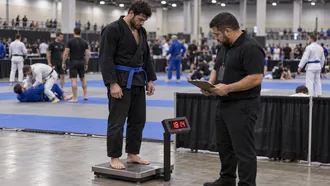
- Weight: compete at your walking-around weight. Don't cut weight for your first tournament. Check the BJJ weight classes for your event, and remember the IBJJF weighs you in your gi.
- Gi or no-gi: do whichever you train most. If you train both, gi matches are usually slower and more forgiving for a first-timer.
- Organization: choose an event that gives you more than one match if possible. Fuji, the Revolution and NAGA are all friendly for first-timers. Weigh-ins, brackets and divisions vary a lot between IBJJF, NAGA, Fuji and AGF.
- Skip the absolute. Get your weight division done first.
Give yourself six to eight weeks from signing up to tournament day. That's enough time for a focused comp training block with harder rounds, some cardio and a lighter final week.
What If You Lose?
You probably will. Most brackets are single elimination, so in a bracket of eight, seven people lose. That's normal.
Losing your first match is a rite of passage, and half your gym has a story about theirs. Watch the video, write down one thing you'd do differently, and take it back to class on Monday. The second tournament is always easier than the first.
When you're ready to go, find BJJ tournaments near you, and use the first BJJ competition checklist for packing your bag and planning match day.
Frequently Asked Questions
Can a white belt compete in BJJ?
Yes. Every major tournament has white belt divisions, and NAGA has novice divisions for people with less than six months of training.
Is 3 months too early to compete in BJJ?
It's early, but not too early if you pick the right event. A NAGA novice division or an in-house gym tournament puts you against people at the same level. Talk to your coach first.
Do I need a stripe to compete?
No. Stripes don't affect which division you enter. You compete by belt color (or by experience at NAGA no-gi).
How many tournaments should a white belt do?
There's no set number. Two or three a year is plenty for most hobbyists. Some competitive white belts do one a month.
Should my first tournament be gi or no-gi?
Whichever you train more. If it's an even split, gi matches tend to be slower, which gives you more time to think.