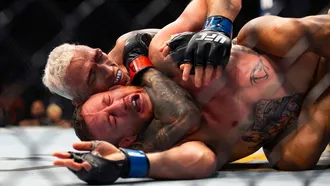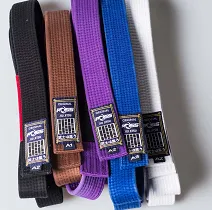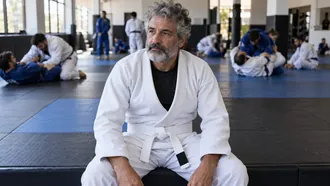
No. You're not too old to start BJJ. Every decent gym has a guy in his 50s who started in his 40s and is now a nightmare to pass. The real question is how you should train.
Starting at 30, 40 or 50 does change things. Recovery is slower, injuries take longer to heal, and you can't go to war with the 22-year-old wrestlers every round and expect to work the next morning. But jiu-jitsu suits older beginners better than almost any other combat sport. There's no striking to the head, you can tap whenever you want, and the art was literally shaped by a small, unathletic man who was still on the mats in his 90s.
Starting at 30, 40, 50 and 60
Starting BJJ at 30
Thirty is not old. You'll be in the middle of the age range at most adult classes. You'll recover a bit slower than the college kids, but you'll probably have more patience and less ego, which makes up for it. Plenty of world-class black belts started in their late 20s and 30s.
Starting BJJ at 40
This is where most "am I too old" searches come from, and it's a very common starting age. Kids are a bit older, careers are settled, and people want something better than the treadmill. Expect your first few months to hurt in places you didn't know existed. Expect to need an extra rest day. And expect to be fine.
Starting BJJ at 50
Very doable, with some adjustments. Look for a gym with a proper fundamentals program and coaches who'll pair you sensibly. Tell them about any old injuries on day one. You'll do more drilling and positional sparring than all-out rolling, and that's a good thing. Technique is what makes jiu-jitsu work anyway.
Starting BJJ at 60 and beyond
Less common, but it happens. If you have health conditions, get a check-up first and ask your doctor about BJJ and your heart, because live rounds push your heart rate high. Some academies run slower-paced or self-defense focused classes that make a better starting point than a general adult class full of competitors.
Is BJJ Bad for Your Body?
BJJ has a lower injury rate than most people assume, mainly because you can tap and the training partner stops. The injuries that do happen tend to be joints (knees, shoulders, fingers, neck) and they're usually caused by one of three things: not tapping in time, rolling hard with someone much bigger or more reckless, or doing too much too soon. None of that makes jiu-jitsu dangerous by default, and all three get easier to avoid with a bit of ego management.
Is BJJ bad for your knees? Knees are the classic older grappler complaint. Most knee injuries come from twisting under load, getting stuck in a heel hook you didn't tap to, or forcing guard positions your hips don't have the mobility for. Tap early to leg locks, don't fight for inverted guards you're not built for, and consider a knee sleeve if you have history.
Is BJJ bad for your back and neck? Stacking, cranks and getting smashed under heavy pressure take a toll. Strong core and neck work outside the gym helps a lot. So does saying no to rolling with the 110 kg guy who doesn't know what "light" means.
The flip side: many older practitioners say they feel better since they started. More mobility, less weight, better sleep, and a stronger grip than they've had in years. If you want the fitness detail, see whether BJJ builds muscle.
The "Old Man Game"
Ask around any gym and someone will warn you about the old guy. He's slow, he barely seems to move, and somehow you're flat on your back under his shoulder, unable to breathe, for the whole round.
That's the old man game. It's built on pressure, patience and position before submission, rather than speed and flexibility. Typical ingredients:
- Closed guard and half guard. Safe, energy-efficient guard positions that don't need a gymnast's hips.
- Pressure passing. Heavy, slow, shoulder-in-the-jaw top game. Let the young guys burn energy trying to escape.
- Grips and frames. Old man strength is mostly about knowing exactly where to hold and when to stop moving.
- Simple, high-percentage submissions. Collar chokes, arm triangles, Americanas. No flying anything.
Hélio Gracie is the original example. He was the smallest and least athletic of the Gracie brothers, adapted what he learned to rely on leverage, and kept training into his 90s. You don't need to be explosive. You need to be patient.
How to Train Smart After 40
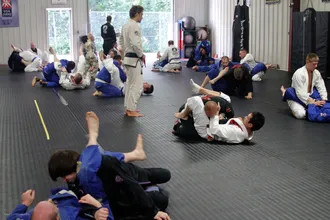
- Start with fundamentals classes. Most gyms have them. If you're not sure what to expect, read what a BJJ class is like first.
- Two or three sessions a week is plenty. More isn't better if you can't recover from it.
- Pick your rounds. Nobody expects you to roll every round. Sit out the shark tank. Skip the rounds with the spazzy white belt. You're there for the long game.
- Tap early, with zero shame. A 45-year-old ego is still an ego. Leave it at the door.
- Warm up properly. Get there 10 minutes early and move your hips, shoulders and neck before class starts.
- Lift a little. Two short strength sessions a week protect your joints more than anything else you can do off the mat.
- Gear up. A mouthguard, knee sleeves if you need them, and ear guards if you'd rather not end up with cauliflower ear.
Competing as a Master
If you want to compete, you won't be thrown in against 20-year-olds unless you choose to be. The IBJJF runs Masters divisions by birth year:
| Division | Minimum age (in the competition year) |
|---|---|
| Master 1 | 30 |
| Master 2 | 36 |
| Master 3 | 41 |
| Master 4 | 46 |
| Master 5 | 51 |
| Master 6 | 56 |
| Master 7 | 61 |
Most local tournaments follow a similar structure, though the exact age bands vary by organization, so check the rules before you register. The IBJJF Masters Worlds in Las Vegas is one of the biggest events on the calendar, which tells you how many people are still competing well past 30. If you're thinking about it, learn how BJJ competitions work first, then look for BJJ tournaments near you.
Will You Still Get Promoted?
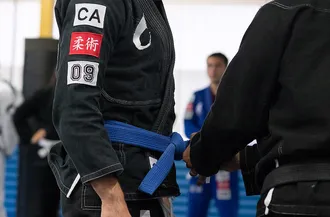
Yes. Adults get promoted on the same belt system regardless of when they started. A 50-year-old white belt follows the same path as a 25-year-old: stripes along the way and a blue belt somewhere around the 1.5 to 3 year mark. Good coaches judge you on your technique and understanding, not on your ability to out-scramble the college kids.
The one real disadvantage of starting later is time. If you start at 50 and train consistently, you could be a black belt in your early 60s. Plenty of people have done exactly that.
Still on the fence? BJJ is hard to learn at any age, but the first class is the same for everyone. Find a BJJ gym near you, ask if they have other students your age (they will), and book a trial.
Frequently Asked Questions
How old is too old to start BJJ?
There isn't a hard cut-off. People regularly start in their 40s and 50s, and some start in their 60s. If you're healthy enough for moderate exercise and willing to train at a sensible pace, you're not too old.
Can you get a black belt if you start at 40?
Yes. At a typical pace of 8 to 12 years, someone starting at 40 could earn a black belt around 50. Consistency matters far more than age.
What age is a master in BJJ?
In IBJJF competition, the Masters categories start at 30 (Master 1) and go up in roughly five-year steps to Master 7 at 61 and older. It's based on the year you were born, not your exact birthday.
Is BJJ bad for your knees?
It can be if you train carelessly. Most knee injuries come from twisting under load or not tapping to leg locks in time. Tapping early, avoiding positions your body can't handle, and doing some strength work off the mat lowers the risk a lot.