You win a BJJ match by submission. If nobody taps, you win on points, then advantages, then penalties, and if it's still dead even, the referee decides. That's the short version of the IBJJF rules, which most gi and no-gi tournaments use as their starting point.
The long version matters, because most first-time competitors don't lose to a better grappler. They lose to a rule they didn't know. They let go of the pass before three seconds, get penalized for stalling while up by two, or reap the knee and get told to stand up and leave. Here's how scoring really works, what's illegal at each belt, and how NAGA and ADCC do it differently.
How You Win a BJJ Match
Under IBJJF rules, the order goes like this:
- Submission. Your opponent taps, verbally submits, or the referee stops it. Game over, regardless of the score.
- Points. If time runs out, whoever has more points wins.
- Advantages. If points are tied, more advantages wins.
- Penalties. Still tied? The athlete with fewer penalties wins.
- Referee decision. If everything is level, the referee picks the winner based on who was more active and closer to finishing.
Disqualification can also end it early, either for a serious foul like a slam or for collecting four penalties.
The BJJ Point System
Points reward reaching a better position. The more control a position gives you, the more it's worth.
| Position | Points | What it means |
|---|---|---|
| Takedown | 2 | Take them from standing to the ground and land on top. |
| Sweep | 2 | From guard, reverse the position and end up on top. |
| Knee on belly | 2 | Knee on their stomach or chest, other foot posted, from top. |
| Guard pass | 3 | Get past their legs and settle into side control or north-south. |
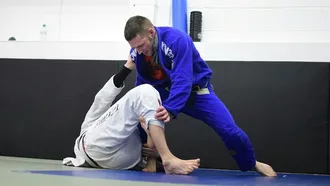
| Mount | 4 | Sit on their torso with both knees on the mat. |
| Back control | 4 | Chest to their back with both hooks in (or a body triangle). |
A classic sequence: you pass the guard (3), slide to knee on belly (2), then mount (4). That's 9 points. In tournaments, points add up quickly once the top player starts moving, which is why "position before submission" is the oldest advice in the room.
There are no points for pulling guard, for escaping, or for a submission attempt. If you're stuck on the bottom of closed guard or half guard, the only ways to score are a sweep or a finish.
The Three-Second Rule
Every position has to be held for three seconds to score. Pass the guard, and if they recover guard after two seconds, you get nothing (though you'll usually get an advantage).
This is the single biggest rule that catches white belts out. In the gym you pass and immediately go for the armbar. In a tournament, you pass, settle your hips, count "one, two, three" in your head, and then attack. Coaches yell "hold it!" from the side of the mat for exactly this reason.
If you flow through several positions without pausing, for example a sweep straight into mount, you get points for each position as long as you stabilize the final one for three seconds.
Advantages
An advantage is a near miss. The referee gives one when you almost score points or almost finish a submission:
- A sweep where they scramble back before three seconds.
- A guard pass where they recover guard just in time.
- A deep armbar or choke that they escape.
Advantages only count when points are tied. Plenty of IBJJF finals at every level have been decided 0-0 with one advantage. It's not glamorous, but if you're grinding through a tight bracket, attacking enough to collect advantages is how you win the close ones.
Penalties
Penalties punish stalling and minor fouls. Under the IBJJF system they escalate:
| Penalty | Consequence |
|---|---|
| 1st | Recorded on the scoreboard. Used as a tiebreaker. |
| 2nd | Your opponent gets an advantage. |
| 3rd | Your opponent gets 2 points. |
| 4th | Disqualification. |
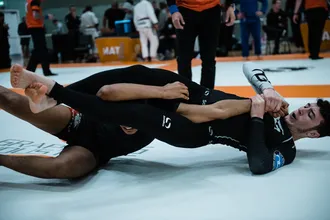
The most common penalty is stalling, especially from the person who's ahead. Being up by two with a minute left and hugging your opponent in closed guard is a good way to hand them an advantage, then two points. Grabbing inside the sleeve or pant leg in the gi and not engaging after a guard pull get penalized too. Fleeing the mat to escape a submission is treated much harder: under IBJJF rules it can get you disqualified, and at minimum your opponent gets 2 points.
Serious fouls, like slamming someone out of a guard, a heel hook in the gi, or bad sportsmanship, skip the ladder entirely and mean instant disqualification.
IBJJF Match Length by Belt
| Belt (adult) | Match length |
|---|---|
| White | 5 minutes |
| Blue | 6 minutes |
| Purple | 7 minutes |
| Brown | 8 minutes |
| Black | 10 minutes |
Juvenile matches are 5 minutes. Master 1 is 5 minutes for white and blue belts and 6 for purple and up, and every masters division from Master 2 (36 and over) is 5 minutes at every belt. Five minutes sounds easy until the adrenaline dump hits at minute two, which is why we recommend competition rounds in your comp prep training week, timed at your real match length.
Illegal Techniques by Belt
The IBJJF opens up more submissions as you go up the BJJ belt ranks. These are the adult rules for the moves people ask about most.
| Technique | White to purple | Brown and black (gi) | Brown and black (no-gi) |
|---|---|---|---|
| Straight ankle lock | Legal | Legal | Legal |
| Kneebar | Illegal | Legal | Legal |
| Toe hold | Illegal | Legal | Legal |
| Heel hook | Illegal | Illegal | Legal (since 2021) |
| Reaping the knee | Illegal | Illegal | Legal (since 2021) |
| Neck cranks | Illegal | Illegal | Illegal |
| Slams | Illegal | Illegal | Illegal |
Masters divisions keep heel hooks and reaping illegal at every belt. If your gym has a purple belt who heel hooks everyone at open mat, that's fine at open mat. At an IBJJF event, it's a DQ.
Reaping is the one that catches people out. It means crossing your leg across the outside of their knee line while you're attacking their leg. You don't need to finish anything for it to be illegal. Just putting your leg there is enough for the referee to stop the match.
Everything else on the list of common BJJ submissions, from the rear naked choke to the kimura, is fair game at every adult belt.
What the Referee Is Shouting
IBJJF referees often use Portuguese commands, which can throw you if no one has told you about them:
- "Combate" means start or restart.
- "Pare" means stop. Freeze where you are.
- "Lute" means fight. You're being told to stop stalling, and a penalty is close.
The referee will also hold up fingers to signal points (two, three or four) and raise a hand flat to signal an advantage. Glance at the scoreboard during a pause. Knowing whether you're up or down with 30 seconds left changes everything.
Grappling Industries Rules
Grappling Industries is where a lot of coaches send first-timers, because you get mat time. Instead of one-and-done brackets, most divisions run as a round robin, so you're guaranteed at least two matches even if the first one goes badly. The scoring is close enough to IBJJF that nothing will feel foreign, but there are a few differences worth knowing before you step on the mat.
Scoring
The points are the same as the IBJJF point system: 4 for mount or back control, 3 for a guard pass, and 2 for a sweep, takedown or knee on belly. Every position has to be held for 3 seconds. The differences:
- No advantages. Grappling Industries doesn't use them at all.
- 2 points for a submission attempt that goes out of bounds. If you had a real finish locked in and the match spilled off the mat, the referee can still reward it, as long as your opponent wasn't deliberately escaping off the edge.
- Back control needs hooks. A body triangle from the back doesn't score back points.
- Ties go to penalties, then the referee. Level on points means the competitor with fewer penalties wins. Still level, and the referee decides, with submission threats counting most.
Penalties and Stalling
The referee can call stalling after 20 seconds without a real attempt to progress. For minor fouls, the first penalty is a warning, the second gives your opponent 2 points, and the third is a disqualification. Major fouls are an instant DQ.
Match Length and Format
Every adult, masters and seniors match is 5 minutes, whatever your belt. Teens aged 14 to 17 go 4 minutes and kids 13 and under go 3. How many matches you get depends on the size of your division:
| Competitors in division | Format | Matches per competitor |
|---|---|---|
| 2 | Best two out of three | 2 to 3 |
| 3 | Round robin | 2 |
| 4 | Round robin | At least 3 |
| 5 | Round robin | 4 |
| 6 to 9 | Round robin groups, top 2 go to a final | 4 to 5 |
| 10 or more | Round robin groups, top 4 go to semis and a final | 4 to 6 |
Ties in a group are broken by most wins, then most submissions, then the head-to-head result, then points scored and points conceded. Absolute divisions are single elimination, and they're only open to adults. Brackets are fully random, so if you and your training partner sign up for the same division, you might have to roll for real.
Weigh-Ins
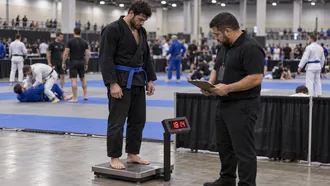
You can weigh in any time up to 60 minutes before your division starts, and gi competitors weigh in without the gi, which takes a lot of the stress out of making weight. If you're doing gi and no-gi on the same day, you only weigh in once. Miss weight, though, and you're out. There's no moving up a class on the day and no refund.
Legal Techniques by Level
Like the IBJJF, Grappling Industries opens up more submissions as you move up the ranks. Kids and teens get the shortest list, and the spicy leg locks are saved for the most experienced no-gi divisions.
| Technique | Under 18 | Adult white belt | Blue belt, and purple belt in gi | Purple belt in no-gi, brown and black |
|---|---|---|---|---|
| Arm locks | ✓ Legal | ✓ Legal | ✓ Legal | ✓ Legal |
| Gi chokes | ✓ Legal | ✓ Legal | ✓ Legal | ✓ Legal |
| Shoulder locks (kimura, americana, omoplata) | ✓ Legal | ✓ Legal | ✓ Legal | ✓ Legal |
| Rear naked choke | ✓ Legal | ✓ Legal | ✓ Legal | ✓ Legal |
| Arm triangle, anaconda, d'arce | ✓ Legal | ✓ Legal | ✓ Legal | ✓ Legal |
| Guillotine (on the ground) | ✓ Legal | ✓ Legal | ✓ Legal | ✓ Legal |
| Head outside single leg takedown | ✓ Legal | ✓ Legal | ✓ Legal | ✓ Legal |
| Triangle choke (pulling the head) | ✓ Legal | ✓ Legal | ✓ Legal | ✓ Legal |
| North-south choke | ✓ Legal | ✓ Legal | ✓ Legal | ✓ Legal |
| Ezequiel and punch chokes | ✗ Illegal | ✓ Legal | ✓ Legal | ✓ Legal |
| Paper cutter choke | ✗ Illegal | ✓ Legal | ✓ Legal | ✓ Legal |
| Gogoplata | ✗ Illegal | ✓ Legal | ✓ Legal | ✓ Legal |
| No-arm triangle and head scissor | ✗ Illegal | ✓ Legal | ✓ Legal | ✓ Legal |
| Kidney compression (closed guard) | ✗ Illegal | ✓ Legal | ✓ Legal | ✓ Legal |
| Groin stretch | ✗ Illegal | ✓ Legal | ✓ Legal | ✓ Legal |
| Straight and rotational ankle lock | ✗ Illegal | ✓ Legal | ✓ Legal | ✓ Legal |
| Wrist lock | ✗ Illegal | ✓ Legal | ✓ Legal | ✓ Legal |
| Guillotine (standing) | ✗ Illegal | ✓ Legal | ✓ Legal | ✓ Legal |
| Hand smothering | ✗ Illegal | ✓ Legal | ✓ Legal | ✓ Legal |
| Jumping attacks (flying submissions, jumping guard or back take) | ✗ Illegal | ✗ Illegal | ✓ Legal | ✓ Legal |
| Kneebar | ✗ Illegal | ✗ Illegal | ✓ Legal | ✓ Legal |
| Toe hold, Estima lock, boltcutter | ✗ Illegal | ✗ Illegal | ✓ Legal | ✓ Legal |
| Knee reap | ✗ Illegal | ✗ Illegal | ✓ Legal | ✓ Legal |
| Bicep and calf slicer | ✗ Illegal | ✗ Illegal | ✓ Legal | ✓ Legal |
| Cloverleaf | ✗ Illegal | ✗ Illegal | ✓ Legal | ✓ Legal |
| Neck and spinal crank | ✗ Illegal | ✗ Illegal | ✗ Illegal | ✓ Legal |
| Z-lock and hip lock | ✗ Illegal | ✗ Illegal | ✗ Illegal | No-gi only |
| Scissor takedown | ✗ Illegal | ✗ Illegal | ✗ Illegal | No-gi only |
| Heel hook (inside and outside) | ✗ Illegal | ✗ Illegal | ✗ Illegal | No-gi only |
| Attacks to the trachea | ✗ Illegal | ✗ Illegal | ✗ Illegal | ✗ Illegal |
| Slams | ✗ Illegal | ✗ Illegal | ✗ Illegal | ✗ Illegal |
"No-gi only" means brown and black belts can use those moves in no-gi divisions, but not in the gi. Under 18 and adult white belt competitors who reap the knee without a submission get a penalty and the referee resets the position. A second reap, or a reap combined with a submission, is a DQ. Controlled suplex-style takedowns aren't counted as slams, but any takedown that spikes your opponent on their head or neck is.
Rules can change between seasons, so check the official Grappling Industries rules before you register. This summary is based on their rulebook dated February 2026.
NAGA, Fuji and ADCC Rules
Every organization starts from roughly the same place, but the differences matter when you're planning a game plan.
- NAGA: gi divisions follow IBJJF-style scoring, with one twist: a back take locked in with a body triangle or crossed feet scores nothing, so get your hooks in. No-gi divisions use NAGA's own points, which reward takedowns, back takes and dominant positions, and give 1 or 2 points for a submission attempt depending on how close it was. There are no advantages in no-gi, so a tie goes to the referee's call, and only if it's still dead even do you get one overtime round. Adult heel hooks are legal from Intermediate up, never in Novice or Beginner. Adult matches run 4 minutes for Novice and Beginner, 5 for Intermediate and 6 for Expert, and every Masters match is 4.
- Fuji: scoring mirrors the IBJJF (2 for a takedown, sweep or knee on belly, 3 for a pass, 4 for mount or back). Advantages only count for real submission attempts, and there are no draws: a tied match goes to the referee's decision. Heel hooks are only legal in the adult Expert no-gi division.
- ADCC: no positive points in the first half of the match, only penalties. Points start counting in the second half, and pulling guard costs you a negative point. It's designed to push people to wrestle and attack submissions rather than ride out a lead.
- Submission only: no points at all, and what happens when time runs out depends on the event. The submission-only rules section below covers the three versions you'll run into.
Submission-Only Rules
Sub-only is exactly what it sounds like. No points, no advantages, and no winning by riding mount for the last two minutes. You either get the tap or you deal with whatever happens when the clock runs out, and that's the part that changes from event to event.
| Format | If nobody taps | Example |
|---|---|---|
| Sub-only with EBI overtime | Overtime rounds from back control or the spider web. Fastest finish or fastest escape wins. | EBI, Flow Sub Only |
| Sub-only with a decision | Judges or the referee pick the winner based on who attacked more and controlled the match. | Polaris |
| Sub-only with draws | The match is a draw. You'll mostly see this in superfights, since a bracket needs someone to move on. | Early Metamoris (Roger Gracie vs Buchecha in 2012 ended in a draw) |
How EBI overtime works
Eddie Bravo's format is the one most local sub-only events borrow. Regulation is ten minutes. If nobody taps, it goes to overtime:
- Each round, both athletes get one turn on offense. The attacker picks the starting position: back control with both hooks and a seatbelt, or the spider web, which is the armbar position with one arm hooked and the other hand posted on the mat.
- Each turn is capped at two minutes. The clock runs until the attacker finishes or the defender escapes.
- If the first attacker gets the tap, the second has to finish faster or they lose. If only one of you finishes, that person wins.
- If nobody finishes in three rounds, each athlete's escape times are added up and the lowest total wins.
Say you take the back first and your opponent gets out in 40 seconds. Then they take your back and you're out in 25. Nobody finished, so you go again. If all three rounds go that way, you win on total escape time. In EBI overtime your escapes are your points, so drilling back escapes matters as much as drilling the bow and arrow.
Since September 2026, an escape only counts once you've recovered some kind of guard or come up on top with your neck and arms safe. Spin out of the back and straight into mount and the clock keeps running. Leg locks are off the table in overtime, apart from attacks off the truck like the calf slicer and banana split.
Plenty of local events run their own spin on it. Flow Sub Only, for example, only lets kids start from the back. Read the overtime rules for your event before you assume it's straight EBI.
What sub-only changes about your game
A sweep is worth nothing. Neither is a guard pass you can't follow up on. Going for the heel hook you'd never risk under points starts to make sense, because losing position costs you nothing on the scoreboard. And the guy with granite defence and quick escapes is more dangerous than he looks, because overtime rewards getting out fast.
Before any tournament, read the rules page on its registration site. It takes ten minutes and saves you from finding out about a rule from the referee.
Knowing the rules is half of preparing for your first BJJ competition. The other half is making weight, so check the BJJ weight classes for your event well before registration closes.
Frequently Asked Questions
How many points is a takedown in BJJ?
Two points under IBJJF rules, as long as you land on top and hold it for three seconds.
Is pulling guard legal in BJJ?
Yes, at the IBJJF and most gi tournaments. You don't score for it, and you can't pull guard and then refuse to engage. In ADCC, pulling guard costs you a negative point.
How many points is taking the back?
Four. You need both hooks in (or a body triangle) and to hold the position for three seconds.
Can white belts do heel hooks?
Not at IBJJF events. Heel hooks are only legal for adult brown and black belts in no-gi. Some other organizations allow them at lower levels in no-gi, so check the rules for your event.
Does a submission attempt score points?
Not under IBJJF rules. A close submission attempt earns an advantage, which only counts if points are tied.
What is the most common way to lose on penalties?
Stalling, usually by the person who's ahead late in the match. The referee will shout "lute" first, then start giving penalties.