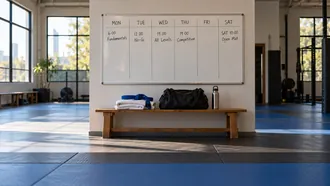
Most BJJ schedule advice assumes you've got nothing else going on. Real life has jobs, kids, night shifts and a knee that complains when it rains. Below are six sample training weeks for six different people, so you can find the one that looks most like your life and steal it.
If you only want the short answer, training BJJ two to three times a week works for most adults. This page is about what those weeks actually look like.
Is Once a Week Enough for BJJ?
Once a week is enough to stay in the game. It's not really enough to improve quickly. With six days between classes you'll forget a lot of the technique, and your cardio won't build much. You'll still progress, just slowly, and the promotions will take longer.
If once a week is all your life allows right now, make it count. Go to the class with the most rolling, write down what you learned, and try to add a second session when things calm down. One class a week for a year beats three a week for a month and then quitting.
The 9-to-5 Hobbyist (3 sessions)
The classic. Office job, evenings mostly free, wants to get better without it taking over their life.
| Day | Session |
|---|---|
| Monday | Evening class (technique and rolling) |
| Tuesday | Rest or a short walk |
| Wednesday | Evening class |
| Thursday | Lift for 45 minutes |
| Friday | Rest |
| Saturday | Open mat |
| Sunday | Rest |
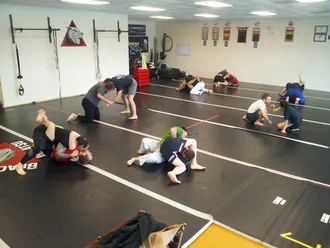
The Saturday open mat is where a lot of hobbyists get better fastest. No set curriculum, just rounds with people from other classes and sometimes other gyms. Bring water and don't say yes to "one more round" every time.
The Parent (2 to 3 sessions, early mornings)
Evenings belong to dinner, homework and bedtime. Enter the 6am class crew, the most committed and most caffeinated group in any gym.
| Day | Session |
|---|---|
| Tuesday | 6am class |
| Thursday | 6am class |
| Saturday or Sunday | Weekend class or open mat (if the family schedule allows) |
Morning classes tend to be smaller, which means more attention from the coach. Not every academy runs them, so check class times before you sign up. You can find BJJ gyms near you and compare schedules. Some gyms also run kids' classes at the same time as adult ones, which solves two problems at once.
The Shift Worker (2 sessions, flexible)
Nurses, police, firefighters, hospitality. Plenty of shift workers train, and they're usually the first to find out which gyms run lunchtime classes.
- Pick a gym with classes at different times of day, including lunchtime or late morning.
- Aim for two sessions per week, whenever your rota allows. Don't stress about which days.
- Avoid hard rolling straight after a night shift. Drill, or flow roll, or just go home and sleep.
- Use open mats to fill gaps when you miss your usual classes.
The 40+ Grappler (2 to 3 sessions plus recovery)
Recovery takes longer after 40, so the week needs more space between hard sessions.
| Day | Session |
|---|---|
| Monday | Class, pick your rounds |
| Tuesday | Mobility for 20 minutes |
| Wednesday | Strength session |
| Thursday | Class |
| Friday | Rest |
| Saturday | Optional light class or flow rolls |
| Sunday | Rest |
Sit out the shark tank. Skip rounds with the guy who's trying to win the Tuesday night world championship. That goes double if you're starting BJJ at 30, 40 or 50 and still learning how your body recovers.
Six Weeks Out From a Tournament (4 to 5 sessions)
Comp prep is temporary. You train harder for a few weeks, then back off. Nobody should train like this all year.
| Weeks out | Focus |
|---|---|
| 6 to 4 | 4 to 5 sessions a week. More hard rounds. Drill your A-game. Two short strength sessions. |
| 3 to 2 | Competition-style rounds: 5 or 6 minutes, starting standing, with someone keeping score. Start watching your weight. |
| Final week | Deload. Light drilling and a couple of easy rolls. No new techniques. Sleep. Don't panic about the weigh-in. |
The comp-week weight cut panic is a rite of passage, but you can avoid it by staying within a few kilos of your division all year. Learn the rules and divisions for your first BJJ competition well before the day, then look for upcoming BJJ tournaments near you.
Take a deload week after the tournament too. Win or learn, your body needs it.
Coming Back From Injury
Long layoffs are when a lot of people quit BJJ for good. The trick is to come back gradually rather than all at once.
- Week 1 to 2: One or two classes. Drill only. Watch the rolling.
- Week 3 to 4: Two classes. Add positional sparring and flow rolls with partners you trust.
- Week 5 onward: Two to three classes. Start live rolling, but tap early and stay away from the gym's heavy hitters for a while.
Follow your doctor or physio's advice first. Tell your coach what you're coming back from so they can pair you sensibly.
Keeping a BJJ Training Journal
Writing a few notes after class is the cheapest way to get better faster. You'll remember more, spot patterns in your rolling, and have a record of progress for the days when it feels like you're going nowhere.
Keep it short. Five lines on your phone is enough:
- Date and class: Wednesday evening, gi.
- Technique: Scissor sweep from closed guard.
- What worked: Got the sweep twice on a new white belt.
- What didn't: Got stuck under side control again. Ask the coach about frames.
- Body: Left shoulder a bit sore.
Read it back once a month. You'll be surprised how much you've improved.
Where Lifting Fits
Two short strength sessions a week fits most of these schedules. Put them on non-BJJ days, or after a light class, and keep them simple. Two sessions a week is plenty to build muscle alongside BJJ without leaving you too cooked to roll.
Frequently Asked Questions
Is training BJJ once a week enough?
It's enough to keep learning, slowly. Two to three sessions a week gives much better progress, but once a week is far better than not training at all.
Can you train BJJ every day?
Some people do, especially competitors and full-time athletes. Most hobbyists will get injured or burn out training hard every day. If you train often, mix hard days with drilling and flow rolling.
Are morning BJJ classes good?
Yes, especially for parents and people with busy evenings. Morning classes are often smaller, so you get more attention from the coach. Not every gym offers them, so check class schedules first.
How many rest days do you need from BJJ?
Most adults do well with at least one rest day between hard sessions. Older grapplers and people recovering from injury usually need more.