Yes, BJJ has weight classes, and every major organization runs its own chart. The IBJJF weighs you in your gi seconds before your first match with zero allowance. NAGA lets you weigh in the night before in shorts with a pound to spare. Fuji gives you two pounds. Pick the wrong chart and you can find yourself standing on a scale in a soaked gi, a hundred grams over, watching your entry fee disappear.
Below are the current adult charts for the IBJJF, NAGA, Fuji and ADCC, plus how weigh-ins actually work and whether cutting weight for a jiu-jitsu tournament is ever worth it.
IBJJF Men's Gi Weight Classes
The IBJJF chart is the one most other gi tournaments copy, so it's worth knowing even if you never enter an IBJJF event. The key detail is that these limits include your gi. A thick competition gi can easily add a few pounds, so your real body weight needs to sit comfortably under the number.
| Division | Limit (with gi) |
|---|---|
| Rooster | 127 lb (57.5 kg) |
| Light Feather | 141.6 lb (64 kg) |
| Feather | 154.6 lb (70 kg) |
| Light | 168 lb (76 kg) |
| Middle | 181.6 lb (82.3 kg) |
| Medium Heavy | 195 lb (88.3 kg) |
| Heavy | 208 lb (94.3 kg) |
| Super Heavy | 222 lb (100.5 kg) |
| Ultra Heavy | No limit |
Middle and Medium Heavy are usually the deepest brackets at adult level. If you walk around at 185 lb (84 kg) and wear a heavy gi, you're Medium Heavy whether you like it or not.
IBJJF Men's No-Gi Weight Classes
The no-gi side of the sport uses the same division names, but the limits drop by roughly 4 to 7 lb (2 to 3 kg) because you're weighing in wearing a rash guard and shorts instead of a gi.
| Division | Limit |
|---|---|
| Rooster | 122.6 lb (55.6 kg) |
| Light Feather | 136 lb (61.7 kg) |
| Feather | 149 lb (67.5 kg) |
| Light | 162.6 lb (73.5 kg) |
| Middle | 175.6 lb (79.6 kg) |
| Medium Heavy | 188.6 lb (85.5 kg) |
| Heavy | 202 lb (91.6 kg) |
| Super Heavy | 215 lb (97.5 kg) |
| Ultra Heavy | No limit |
IBJJF Women's Weight Classes
Women's divisions start lighter and stop at Super Heavy, which has no upper limit. These are the gi limits, again with the gi on.
| Division | Limit (with gi) |
|---|---|
| Rooster | 107 lb (48.5 kg) |
| Light Feather | 118 lb (53.5 kg) |
| Feather | 129 lb (58.5 kg) |
| Light | 141.6 lb (64 kg) |
| Middle | 152.6 lb (69 kg) |
| Medium Heavy | 163.6 lb (74 kg) |
| Heavy | 175 lb (79.3 kg) |
| Super Heavy | No limit |
Women's no-gi limits run about 4 to 6 lb (2 to 3 kg) under the gi numbers.
| Division | Limit |
|---|---|
| Rooster | 103 lb (46.7 kg) |
| Light Feather | 114 lb (51.7 kg) |
| Feather | 125 lb (56.7 kg) |
| Light | 136 lb (61.6 kg) |
| Middle | 147 lb (66.7 kg) |
| Medium Heavy | 158 lb (71.6 kg) |
| Heavy | 169 lb (76.6 kg) |
| Super Heavy | No limit |
Check the IBJJF chart for your event before you register, because brackets at smaller opens are sometimes merged when only one or two women sign up.
NAGA Weight Classes
NAGA does things differently. US weight classes are set in pounds, mostly in 10 lb (4.5 kg) steps until the heavier classes, you weigh in without a gi even for gi divisions, and there's a 1 lb (0.45 kg) allowance. You can weigh in the night before or on the morning of the event, which takes a lot of the stress out of it. If you go same day, adults need to be on the scale 60 to 90 minutes before their division starts. You only weigh in once, even if you're doing gi and no-gi.
| Men | Weight | Women | Weight |
|---|---|---|---|
| Flyweight | Up to 129.9 lb (58.9 kg) | Sub-Atomic | Up to 99.9 lb (45.3 kg) |
| Bantamweight | 130 to 139.9 lb (59 to 63.5 kg) | Atomweight | 100 to 109.9 lb (45.4 to 49.8 kg) |
| Featherweight | 140 to 149.9 lb (63.5 to 68 kg) | Strawweight | 110 to 119.9 lb (49.9 to 54.4 kg) |
| Lightweight | 150 to 159.9 lb (68 to 72.5 kg) | Flyweight | 120 to 129.9 lb (54.4 to 58.9 kg) |
| Welterweight | 160 to 169.9 lb (72.6 to 77.1 kg) | Bantamweight | 130 to 139.9 lb (59 to 63.5 kg) |
| Middleweight | 170 to 179.9 lb (77.1 to 81.6 kg) | Featherweight | 140 to 149.9 lb (63.5 to 68 kg) |
| Light Heavyweight | 180 to 189.9 lb (81.6 to 86.1 kg) | Lightweight | 150 to 159.9 lb (68 to 72.5 kg) |
| Cruiserweight | 190 to 199.9 lb (86.2 to 90.7 kg) | Welterweight | 160 to 169.9 lb (72.6 to 77.1 kg) |
| Heavyweight | 200 to 224.9 lb (90.7 to 102 kg) | Middleweight | 170 to 179.9 lb (77.1 to 81.6 kg) |
| Super Heavyweight | 225 to 249.9 lb (102.1 to 113.4 kg) | Light Heavyweight | 180 to 189.9 lb (81.6 to 86.1 kg) |
| Ultra Heavyweight | 250 lb and up (113.4 kg+) | Cruiserweight | 190 to 199.9 lb (86.2 to 90.7 kg) |
| Heavyweight | 200 lb and up (90.7 kg+) |
NAGA's European events run their own chart in kilograms, with 5 kg steps through the middle of the range.
| Men (NAGA Europe) | Weight | Women (NAGA Europe) | Weight |
|---|---|---|---|
| Flyweight | 59.9 kg and under | Sub-Atomic | 44.9 kg and under |
| Bantamweight | 60 to 64.9 kg | Atomweight | 45 to 49.9 kg |
| Featherweight | 65 to 69.9 kg | Strawweight | 50 to 54.9 kg |
| Lightweight | 70 to 74.9 kg | Flyweight | 55 to 59.9 kg |
| Welterweight | 75 to 79.9 kg | Bantamweight | 60 to 64.9 kg |
| Middleweight | 80 to 84.9 kg | Featherweight | 65 to 69.9 kg |
| Cruiserweight | 85 to 89.9 kg | Lightweight | 70 to 74.9 kg |
| Heavyweight | 90 to 99.9 kg | Welterweight | 75 to 79.9 kg |
| Super Heavyweight | 100 to 114.9 kg | Middleweight | 80 to 84.9 kg |
| Ultra Heavyweight | 115 kg and over | Cruiserweight | 85 to 89.9 kg |
| Heavyweight | 90 kg and over |
NAGA also splits adult no-gi divisions by grappling experience instead of belt, and it counts everything: wrestling, judo and sambo all go on the tab.
- Novice: 6 months or less.
- Beginner: 6 months to 2 years.
- Intermediate: 2 to 5 years. Blue belts have to enter at least Intermediate.
- Expert: 5 years or more. Purple, brown and black belts have to enter Expert.
That's why a 170 lb (77 kg) guy with four months on the mats won't be thrown in with a 170 lb state-placing wrestler, at least on paper. If someone keeps winning Beginner, NAGA can bump them up a level, which is its answer to the sandbagger. Gi divisions go by belt as normal.
NAGA's age groups have their own names too: Adult (18 to 29), Master (30 to 39), Director (40 to 49) and Executive (50 and over). You can always drop down and enter a younger age group as well as your own. If nobody else signs up for your bracket, NAGA combines you with the next closest weight or age group.
Fuji Weight Classes
Fuji keeps it simple. The adult gi and no-gi charts are identical, they're set in round pounds, and you weigh in without your gi, so nobody's hunting for the lightest pearl weave in the shop the week before.
| Division | Weight range |
|---|---|
| Under 100 lb (45.4 kg) | Up to 100 lb |
| Under 110 lb (49.9 kg) | 100.1 to 110 lb |
| Under 120 lb (54.4 kg) | 110.1 to 120 lb |
| Under 130 lb (59 kg) | 120.1 to 130 lb |
| Under 140 lb (63.5 kg) | 130.1 to 140 lb |
| Under 150 lb (68 kg) | 140.1 to 150 lb |
| Under 165 lb (74.8 kg) | 150.1 to 165 lb |
| Under 180 lb (81.6 kg) | 165.1 to 180 lb |
| Under 195 lb (88.5 kg) | 180.1 to 195 lb |
| Under 210 lb (95.3 kg) | 195.1 to 210 lb |
| Under 225 lb (102.1 kg) | 210.1 to 225 lb |
| Above 225 lb (102.1 kg) | 225.1 lb and up |
The steps are 10 lb (4.5 kg) at the light end and 15 lb (6.8 kg) from 150 lb up, so heavier guys have a bit more room than at NAGA. Fuji also allows 2 lb (0.9 kg) over the listed limit, and you can weigh in up to an hour before your division.
Fuji notes that divisions can change from event to event, so check the divisions tab on the Smoothcomp page for your tournament before you register.
ADCC Weight Classes
ADCC is no-gi only, and it runs two different charts. The World Championship and the Trials that qualify people for it use a handful of wide classes. Jumps of about 24 lb (11 kg) for men mean someone in every bracket is giving up real size, and you have to be over 16 to enter.
| Men | Women |
|---|---|
| Up to 145.3 lb (65.9 kg) | Up to 121.3 lb (55 kg) |
| Up to 169.5 lb (76.9 kg) | Up to 143.3 lb (65 kg) |
| Up to 193.8 lb (87.9 kg) | Over 143.3 lb (65 kg) |
| Up to 218 lb (98.9 kg) | |
| 218.3 lb (99 kg) and over | |
| Absolute (open weight) |
The ADCC Opens and national events, the ones most hobbyists actually sign up for, use a tighter chart with more classes. Adults are 18 and over, and Masters 1 starts at 35.
| Men | Women |
|---|---|
| Up to 132.3 lb (60 kg) | Up to 110.2 lb (50 kg) |
| Up to 143.3 lb (65 kg) | Up to 121.3 lb (55 kg) |
| Up to 154.3 lb (70 kg) | Up to 132.3 lb (60 kg) |
| Up to 167.6 lb (76 kg) | Up to 143.3 lb (65 kg) |
| Up to 183 lb (83 kg) | Up to 154.3 lb (70 kg) |
| Up to 200.6 lb (91 kg) | Over 154.3 lb (70 kg) |
| Up to 220.5 lb (100 kg) | |
| Over 220.5 lb (100 kg) |
Like NAGA, ADCC Opens split divisions by grappling experience, and wrestling, judo and sambo all count: Beginner is under 2 years, Intermediate is 2 to 4 years, and Advanced and Professional are for people with more than 5 years.
Masters and Juvenile Divisions
Age divisions don't change the weight limits. A Master 3 Middle at the IBJJF has the same 181.6 lb (82.3 kg) cap as a 22-year-old adult Middle. What changes is who you're paired against and, often, how long the match is.
The IBJJF goes by the age you turn during the calendar year, not your age on the day. If you turn 30 in December, you can enter Master 1 in January.
| IBJJF division | Age | Match length |
|---|---|---|
| Juvenile 1 | 16 | 5 minutes |
| Juvenile 2 | 17 | 5 minutes |
| Adult | 18 and over | 5 (white) to 10 (black) minutes |
| Master 1 | 30 and over | 5 minutes (white, blue), 6 minutes (purple and up) |
| Master 2 | 36 and over | 5 minutes |
| Master 3 | 41 and over | 5 minutes |
| Master 4 | 46 and over | 5 minutes |
| Master 5 | 51 and over | 5 minutes |
| Master 6 | 56 and over | 5 minutes |
| Master 7 | 61 and over | 5 minutes |
NAGA and ADCC use their own age bands, covered in their sections above, and ADCC Masters start at 35 instead of 30.
Masters brackets are full of people who started BJJ in their 30s, 40s or later, and they're some of the most fun divisions to watch. Expect a lot of half guard, a lot of pressure and very little berimbolo.
How Weigh-Ins Actually Work
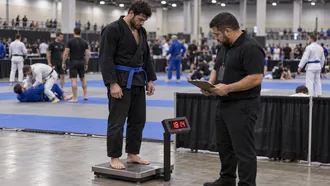
At an IBJJF event you check in at the bullpen, step on the scale in your gi (or rash guard and shorts for no-gi), and then walk straight onto the mat. One attempt. No allowance. If you're over, you're out, and there's no refund.
That last-minute weigh-in is the reason you'll see guys skipping rope in the warm-up area in a full gi, and someone else frantically borrowing a lighter gi from a teammate. Don't be either of those people. Two habits fix almost every weigh-in disaster:
- Weigh yourself in your competition gi a week out, at the same time of day you'll compete. Dry gi, then wet gi after training, so you know the difference.
- Bring a lighter backup gi. A lightweight BJJ gi in the 250 to 450 GSM range can be noticeably lighter than the heavy one you train in, and that difference has saved plenty of people at the scale.
NAGA and Fuji are more forgiving, with weight allowances and gi-off weigh-ins, but the habit of knowing your exact competition weight is worth building early.
Should You Cut Weight for a BJJ Tournament?
For your first few tournaments, no. Compete at your walking-around weight.
Wrestlers and MMA fighters cut weight because they weigh in the day before and have hours to rehydrate. The IBJJF weighs you in minutes before your first match. If you dehydrate yourself to make weight, you step on the mat dry, flat and gassed in the first minute. Every gym has a story about the guy who sat in his car with the heater on all morning, made weight by a hair, and got swept in 30 seconds.
If you're more than a couple of pounds over the line, move up a division. If you want to drop a class, do it slowly over a six-week comp prep block with normal food and normal water, not with a sauna suit the night before.
The exception is NAGA and other day-before weigh-ins, where a small, sensible cut of a pound or two is common among experienced competitors. Even then, being a bit lighter rarely beats being fresh.
The Open Class (Absolute)
The open class, or absolute, is the no-weight-limit bracket. Anyone of the right belt and age can enter, which is how you end up with a 140 lb (63.5 kg) featherweight staring up at a 230 lb (104 kg) ultra heavy. It's where the "jiu-jitsu lets the small guy beat the big guy" story gets tested, and sometimes it even comes true.
At bigger IBJJF events, the open class is usually only available to people who also entered a weight division that day. For a first tournament, skip it. Get your weight division done, see how your body feels, and save the absolute for when you're chasing a bigger challenge.
When you're ready to pick an event, browse the upcoming BJJ tournaments near you and check which rule set and weight chart each one uses. Weight is only one piece of getting ready for your first BJJ competition, but it's the one that can end your day before it starts.
Frequently Asked Questions
Does BJJ have weight classes?
Yes. Every major BJJ tournament has weight classes, and most also run an open class with no weight limit. The exact limits depend on the organization.
Do you weigh in with your gi on?
At the IBJJF, yes. Your gi is part of your weight. At NAGA you weigh in without a gi, even for gi divisions. Fuji also weighs you in without the gi.
What happens if you miss weight?
At the IBJJF you're disqualified from that division with no refund. NAGA and Fuji give small allowances and will sometimes move you to the next division up instead.
What weight class am I in?
Weigh yourself in your competition gear at the time of day you'll compete, then find the first division whose limit is above that number. If you're within a pound of the line at the IBJJF, go up a class.
Are women's and men's weight classes different?
Yes. Women's divisions start lighter (IBJJF Rooster is 107 lb (48.5 kg) with the gi) and have fewer classes at the top, ending at Super Heavy with no upper limit.