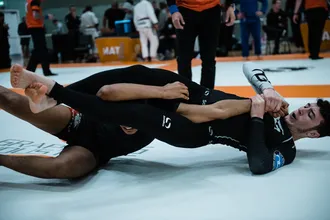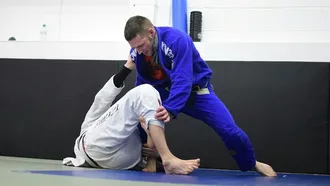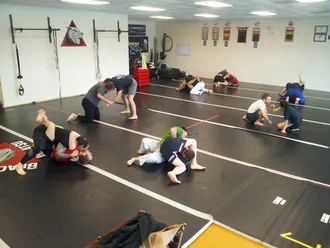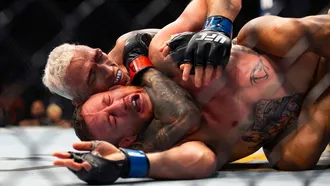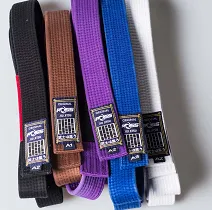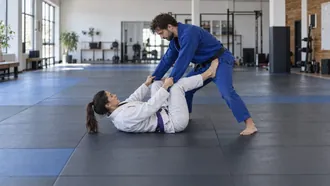
Yes. BJJ is one of the best martial arts for self-defense, especially if you're smaller than the person who wants to hurt you. It teaches you to control someone, get up safely, and end a fight without having to out-punch anyone. It has gaps too. Sport BJJ habits can get you hurt on concrete, and most gyms don't spend enough time on takedowns or strikes.
Below is why it works, where it falls short, and how to train it so it holds up outside the gym.
BJJ Was Built for Real Fights
Modern Brazilian jiu-jitsu started with the Gracie family in the early 1900s, after Carlos Gracie learned judo and jiu-jitsu from Mitsuyo Maeda, a Japanese judoka who had settled in Brazil. Carlos's younger brother Hélio was small and frail, so he adapted the techniques to rely on leverage and timing rather than strength. If you're curious how that split from the Japanese roots, we compare the two in Japanese vs Brazilian jiu-jitsu.
The Gracies proved it the hard way. The "Gracie Challenge" was an open invitation for fighters of any style to come and fight a Gracie, often with few or no rules. Those fights built the family's reputation in Brazil for decades.
Then came UFC 1 in Denver in November 1993. Royce Gracie, a slim guy in a gi, beat a boxer, a shootfighter and a savate fighter in one night, mostly by taking them down and choking them. Nobody watching knew what a rear naked choke was. Within a few years, every serious MMA fighter was learning jiu-jitsu.
That's the core of the self-defense argument. BJJ wasn't designed as a points game. It was designed so a smaller person could survive a fight against a bigger one, and it was tested in fights before it became a sport.
Why BJJ Works in a Street Fight
You train against people who are resisting
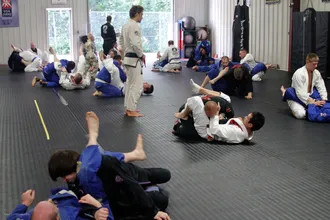
This is the big one. In most BJJ classes you spar (or "roll") against someone actively trying to stop you, several times a week. You find out very quickly what works and what doesn't. The mat doesn't lie. Martial arts that only drill against a compliant partner can't say the same.
You can control someone without hurting them
Most real self-defense situations aren't to-the-death fights. They're a drunk guy at a barbecue, a scuffle outside a bar, or someone you know who's lost their temper. BJJ gives you options short of breaking someone's face: pin them, hold them and let them calm down. That matters legally as well as morally.
Lots of fights end up on the ground
You'll often hear that "90% of fights go to the ground." The figure usually quoted comes from a review of LAPD use-of-force incidents in the late 1980s, popularized by the Gracies, and it's closer to 62%. Even that number is debated, because the original report is hard to pin down. Either way, anyone who's watched a few real fights knows that tripping, tackling and clinching happen constantly. If you end up on the ground, you want to be the one who knows what to do there.
It works for smaller people
Leverage, frames and guard let a smaller person survive under someone heavier and look for a way out. It isn't magic. A trained 60 kg person still struggles against a trained 100 kg person. But against an untrained attacker, technique counts for a lot.
Sport BJJ vs Self-Defense BJJ
This is where some BJJ black belts and self-defense instructors disagree. Sport jiu-jitsu, the kind you see at IBJJF tournaments and the ongoing push to get BJJ into the Olympics, has rules that create habits you wouldn't want in a real fight:
- Pulling guard. Sitting straight down to your back is fine on mats. On concrete, against someone who can punch you or has friends nearby, it's a bad idea. "Don't pull guard on concrete" is a joke in the community because it's true.
- Butt-scooting. Same problem, with extra comedy.
- Ignoring strikes. In a sport roll, you can leave your face open while you work for a grip. In a fight, you get punched.
- Points over position. Competitors learn to chase advantages and points. Self-defense rewards getting up and leaving.
Self-defense focused jiu-jitsu fixes those habits. Programs like Gracie Combatives (a 36-lesson curriculum from Gracie University) build around situations like headlocks, bear hugs and someone mounting you and throwing punches. Some academies also add light strikes during rolls, sometimes just open-hand slaps, so students learn to protect their head while working.
Gi training helps too. Gripping a collar and sleeve translates well to grabbing a jacket or hoodie. The differences between gi and no-gi BJJ matter less here than people argue online. Both have value for self-defense.
Where BJJ Falls Short
Takedowns
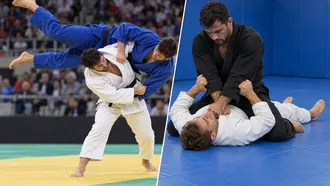
Plenty of BJJ classes start rolling from the knees. That's safer and more efficient, but it means some blue belts have barely practiced getting someone to the ground, or stopping someone from taking them down. Judo and wrestling are much stronger here. If self-defense is your goal, add takedown work or cross-train. We compare the two in BJJ vs judo.
Striking
BJJ doesn't teach you to punch. It teaches you to close distance and clinch so the other person can't punch you effectively. That's useful, but basic boxing or Muay Thai makes you more complete, and it's why almost every MMA fighter trains both.
The environment
Parking lots, bar stools, curbs, broken glass. Rolling around is a lot less appealing off the mats, which is why good self-defense BJJ focuses on staying on your feet when you can, and getting back up fast when you can't.
"But What About..."
Every BJJ student has heard these at a family dinner. They're fair questions, so here are straight answers.
"What about multiple attackers?" Going to the ground against a group is a terrible idea, and no martial art makes you safe against three people. BJJ still helps, because it teaches you to stay balanced, break grips and get back to your feet. Then run.
"What about biting and eye gouges?" Your attacker can bite. So can you. A BJJ player in mount, though, controls where the fight goes, and the bad positions for biting are the same bad positions BJJ teaches you to escape. Being on top beats having a "secret" move.
"What about knives?" If someone has a knife, give them your wallet. If you can't escape, no martial art gives you good odds. BJJ's grip fighting and wrist control are useful skills, but nobody serious would tell you to roll with a blade.
"Doesn't BJJ just teach you to lie on your back?" Sport BJJ can look like that. Self-defense BJJ prioritizes top position, getting up and walking away.
BJJ Self-Defense for Women
BJJ is especially popular with women for self-defense, and for good reason. Many assaults against women involve being grabbed, pinned or held down, which is exactly what jiu-jitsu trains for every class. Escaping from under someone heavier is a core skill from week one. Lots of academies now run women's only classes too, which can make that first step easier.
Choosing a Gym for Self-Defense
Not every BJJ academy teaches self-defense. Some are almost entirely sport-focused, and that's fine if you know it going in. On a trial class, ask:
- Do you teach self-defense techniques, or is it mostly competition BJJ?
- How much time do you spend on takedowns and standing up?
- Do you ever train with strikes?
- How do you pair beginners for sparring?
Then watch a class. If the upper belts look after new students and the coach keeps things under control, you've found a good place to learn. You can find BJJ gyms near you and compare class times and reviews. A room like that is also the best answer to whether jiu-jitsu is dangerous, because most training injuries come from ego, not technique.
And be patient. You'll have a few useful escapes within months, but BJJ takes time to learn. By blue belt, most people can handle an untrained attacker with confidence. The best self-defense is still not being there in the first place.
Frequently Asked Questions
Does BJJ work in a street fight?
Generally, yes. BJJ teaches you to control an untrained attacker, escape bad positions and finish a fight without striking. Its weaknesses are takedowns, striking and fighting multiple people, so supplement it if self-defense is your main goal.
Is BJJ the best martial art for self-defense?
It's one of the best, especially for smaller people. Many experts would say the most complete combination is BJJ plus some striking and takedowns, which is basically MMA. Krav Maga, judo and Muay Thai each have strong arguments too.
Does BJJ teach takedowns?
Some, but usually less than judo or wrestling. Many classes start sparring from the knees. If self-defense is important to you, pick a gym that trains standing or add some wrestling or judo.
How long does it take for BJJ to be useful in self-defense?
A few months of consistent training gives you basic escapes and control. Around blue belt, usually 1.5 to 3 years in, most students can handle an untrained person confidently.