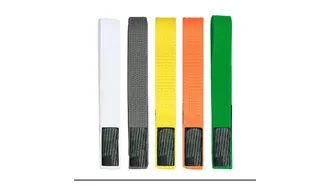
Kids in BJJ don't go white, blue, purple. Under the IBJJF system they get their own ladder of 13 belts: white, then grey, yellow, orange and green, with each color split into three versions. A kid can climb that ladder from age 4 to 15. In the year they turn 16 they move over to the adult belts, and the color they're wearing decides which adult belt they get.
If you're a parent who just watched your 7-year-old get a yellow belt with a white stripe down the middle and nodded like you knew what it meant, this one's for you.
Kids BJJ Belt Order
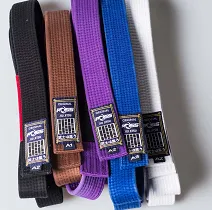
The IBJJF lists 13 ranks for athletes aged 4 to 15. After white, every color comes in three versions. The first has a white line running down the middle of the belt, the second is solid, and the third has a black line down the middle. So a grey and white belt is a grey belt with a white center stripe, not a belt that's half grey and half white.
| Order | Belt | Group |
|---|---|---|
| 1 | White | White |
| 2 | Grey and White | Grey |
| 3 | Grey | |
| 4 | Grey and Black | |
| 5 | Yellow and White | Yellow |
| 6 | Yellow | |
| 7 | Yellow and Black | |
| 8 | Orange and White | Orange |
| 9 | Orange | |
| 10 | Orange and Black | |
| 11 | Green and White | Green |
| 12 | Green | |
| 13 | Green and Black |
Kids belts are also thinner than adult ones. The IBJJF spec is 2.5 to 3.5 cm wide, against 3.5 to 4.5 cm for adults, with the same black bar near one end where the stripes go. Most kids lose them in the car anyway.
Not every academy runs all 13. Some skip the white and black variations and only use solid colors, and plenty of gyms put their own spin on it. If your kid's gym hands out a belt that isn't in this table, it's an in-house rank, so ask the coach where it sits. The adult ladder they join at 16 runs from white to red, and every step of it is in the BJJ belt system.
Minimum Ages for Each Kids Belt
Each color group has a minimum age, and the IBJJF counts age by birth year: current year minus birth year. A kid born in November turns "7" on January 1 for belt and competition purposes, even though the birthday cake is still 10 months away.
| Belt group | Minimum age | IBJJF age divisions |
|---|---|---|
| White | Any age | All |
| Grey (grey/white, grey, grey/black) | 4 | Mighty-Mite 1 to Teen 3 |
| Yellow (yellow/white, yellow, yellow/black) | 7 | Pee-Wee 1 to Teen 3 |
| Orange (orange/white, orange, orange/black) | 10 | Junior 1 to Teen 3 |
| Green (green/white, green, green/black) | 13 | Teen 1 to Teen 3 |
There's no minimum time on any kids belt. Promotions are entirely up to the professor. That's the big difference from the adult side, where a blue belt has to sit for two years before purple is even on the table.
The age divisions run in three-year blocks: Mighty-Mite (4 to 6), Pee-Wee (7 to 9), Junior (10 to 12) and Teen (13 to 15). Line those up against the minimum ages and each new color opens up right as a kid enters a new block. A kid who starts at 4 can't be rushed into yellow, no matter how good their shrimping is.
Grey Belt
The grey belt (spelled gray at plenty of American gyms) is the first colored belt in kids BJJ and the one you'll see most at any Saturday morning kids class. Kids can get grey from age 4. At that age, a grey belt mostly means they can stay on the mat for a whole class, hold closed guard, bridge and shrimp, and know not to cry when they lose at tug of war. That last one takes a while.
Plenty of kids who start at 7 or 8 also go through grey, because the system doesn't force anyone to skip colors. A late starter just spends less time in each one.
Yellow Belt
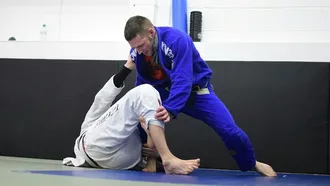
Yellow opens up at 7. By now most coaches expect real positions: mount, side control, back control with hooks, and the first proper submissions like the armbar from guard and the cross collar choke. Yellow belts start rolling with a plan instead of hugging and rolling around until the timer goes off.
Orange Belt
Orange starts at 10. This is where kids BJJ starts to look like the adult version. Orange belts chain techniques together, play guard on purpose, and have usually done a tournament or two. The ones who've been training since Mighty-Mite are often frighteningly technical. Every gym has an orange belt who once tapped a visiting adult white belt and won't let anyone forget it.
Green Belt
Green is the last kids color and starts at 13. Green and black is as far as anyone gets before the adult system takes over. Teens at green are often training in the adult classes, rolling with blue and purple belts and treating the Saturday open mat like a second home. They also get the best deal when they turn 16.
How Stripes Work on Kids Belts
Like adult belts, kids belts have a black bar near one end where coaches tape on stripes (the IBJJF calls them degrees). The difference is that the IBJJF doesn't fix a number for kids. It suggests three systems and leaves the choice to the gym:
| System | Promotion rhythm | Stripes per belt |
|---|---|---|
| Quarterly | Every 3 months | 3 stripes, the 4th promotion is the next belt |
| Every four months | Every 4 months | 2 stripes, the 3rd promotion is the next belt |
| Monthly | Every month | 11 stripes (4 white, 4 red, 3 in the next belt's color), the 12th is the next belt |
All three add up to roughly one year per belt. For the youngest kids on white and grey and white, the IBJJF suggests one stripe a month for six months on each belt.
The monthly system exists for a reason. A 5-year-old doesn't care about a promotion that's a year away, but they'll fight through a whole class for a red stripe at the end of the month. It's the same first stripe energy adults get, just more often and with more high fives. Grown-ups get a simpler four-stripe system and have to wait a lot longer for each one.
What Happens at 16
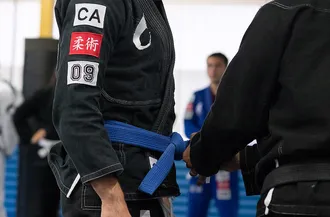
In the year a kid turns 16 they move to the Juvenile division and the adult belt system. Kids colors stay behind. The new belt depends on the old one:
| Kids belt at 15 | Adult belt at 16 |
|---|---|
| White | May stay white |
| Grey, yellow or orange (any version) | Must move to blue |
| Green (any version) | Blue or purple, the professor decides |
Juveniles (16 and 17) can only hold white, blue or purple. Brown belt has a minimum age of 18, and so does black, although black at 18 is reserved for someone who has won the Adult World Championship at brown belt. For everyone else it comes later.
The kids years also cut down adult waiting times. Under IBJJF rules, an adult blue belt normally needs two years before purple. That drops to one year if the athlete was registered as a grey, yellow or orange belt, and to zero for a former green belt. A kid who started at 4 and stuck with it can walk into adult classes at 16 with a purple belt and over a decade of mat time. The 35-year-old who started last spring and is still chasing their first blue belt will not find this funny.
Kids Belts and Competition
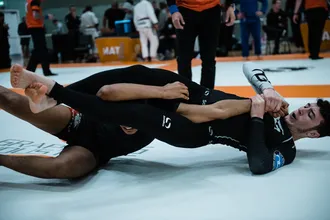
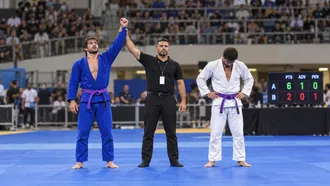
At kids tournaments, brackets are built on age division, belt and weight, so your 8-year-old yellow belt faces other Pee-Wees, not a teenager. Scoring follows the same IBJJF points system adults use, but kids play under stricter rules, and the riskier attacks that adult brown and black belts are allowed, like heel hooks, are off the table.
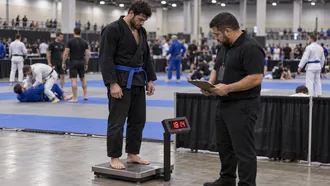
If the tournament weighs kids in their gi, the oversized one you bought to grow into counts on the scale, so it pays to know your gi sizes before registration closes. Kids tournaments have their own culture too: parents losing their voices in the bleachers, coaches crouched at the edge of the mat, and at least one kid who wins a medal and immediately asks for a snack. There's probably one on the BJJ tournament calendar within driving distance.
Nobody has to compete to get promoted. Coaches promote on mat time, attitude and technique, and plenty of solid green belts have never stepped into a bracket.
What to Ask a Kids Program
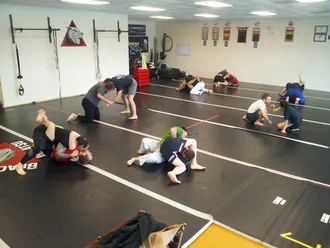
If your kid hasn't started yet, the belt system is a good way to size up a gym on a trial class. Ask which belt system they use, how often promotions happen, and whether stripes are earned or handed out for attendance. A gym that answers clearly usually runs a structured kids curriculum. Sit in on a class before you sign anything, and compare kids programs and parent reviews in the BJJ gym finder.
FAQ
What age can a kid get a blue belt in BJJ?
Not before the year they turn 16. Under the IBJJF system, blue belt has a minimum age of 16, so even the most talented 15-year-old stays on kids belts until then.
Is grey belt higher than yellow in BJJ?
No. Grey comes first, then yellow, orange and green. Grey is the first colored belt after white.
What is the highest kids belt in BJJ?
Green and black. It's the 13th and last kids rank before the adult system starts at 16.
What does the black stripe through the middle of a kids belt mean?
It marks the third and highest version of that color. A white stripe through the middle is the first version, a solid belt is the second, and a black stripe through the middle is the third. The next promotion is a new color.
Is there a green and yellow belt in BJJ?
Not in the IBJJF system. The only two-tone kids belts are each color with a white or black center stripe. If a gym uses green and yellow, it's an in-house rank or a different federation's system, so ask the coach where it fits.
Can adults wear grey, yellow, orange or green belts?
No. Those belts are only for ages 4 to 15. Adults start at white and go straight to blue.
How long does each kids belt take?
The IBJJF sets no minimum time for kids, but all three of its suggested stripe systems add up to about a year per belt. In practice it depends on how often your kid trains and how their gym runs promotions.
Is BJJ safe for kids?
Kids classes are built around positions and controlled drills, kids competition bans the riskier techniques, and a good coach stops a roll long before anyone gets hurt. The bigger picture on BJJ injury risk applies to kids too, just with fewer heel hooks.